Blog / How Much Does E-commerce SEO Cost in India?
How Much Does E-commerce SEO Cost in India? A Realistic Breakdown

If you’ve started researching e-commerce SEO for your online store, you’ve probably noticed the numbers vary a lot. One agency quotes ₹25,000 a month, another quotes ₹2,00,000, and neither fully explains why. Both quotes can be legitimate; they’re usually just built for very different store sizes and scopes of work.
This guide breaks down what e-commerce SEO actually costs in India based on store size, what you should expect to receive at each level, and how to think about the investment realistically.
Why E-commerce SEO Costs More Than Regular SEO
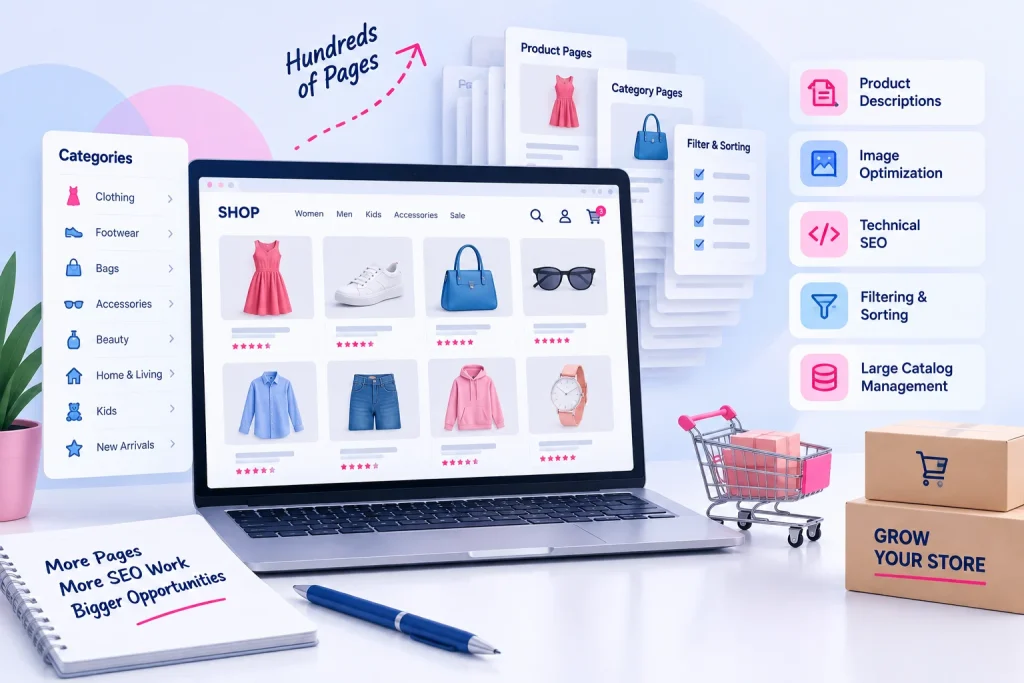
E-commerce sites are simply more work to optimize than a typical business website. A service business might have 10 to 20 pages to manage: a homepage, a few service pages, an about page, a contact page. An online store can have hundreds or thousands of product and category pages, each with its own SEO considerations. Every product page needs a description, proper image optimization, and correct technical markup. Every category page needs to handle filtering and sorting without creating duplicate content. As your catalog grows or changes seasonally, this work doesn’t stop; it scales with you. This is why e-commerce SEO pricing tracks so closely with catalog size, and why the number of SKUs you’re managing is one of the biggest factors in what a fair scope of work actually looks like.E-commerce SEO Pricing by Store Size
Here’s a realistic look at what e-commerce SEO costs in India based on store size.Small Store
(Under 1,000 SKUs)₹25,000 – ₹60,000
per month Technical baseline setup, product schema markup, category optimization, and monthly keyword health reportsMid-Market / Growing Store
(1,000 – 10,000 SKUs)₹60,000 – ₹1,50,000
per month Faceted navigation structure controls, ongoing link acquisition, digital PR, conversion rate optimization (CRO) reviews, and dynamic content strategyLarge Catalogue / Enterprise
(10,000+ SKUs)₹1,50,000 – ₹4,00,000+
per month Crawl budget engineering, advanced indexation handling, programmatic content scaling, a dedicated project strategist, and developer collaborationWhat Good Deliverables Look Like at Each Stage
Small Store (Under 1,000 SKUs)
At this stage, the priority is getting the technical foundation right before investing heavily in scale. This typically includes:✓ Technical baseline setup: making sure your site is crawlable, indexable, and free of basic structural errors that hold back rankings.
✓ Product schema markup: structured data that helps your products display richly in search results, including price, availability, and review stars.
✓ Category optimization: ensuring your category pages are structured clearly, both for shoppers and for search engines trying to understand your site.
✓ Monthly keyword health reports: visibility into which keywords are gaining traction, so you can see progress even before major ranking jumps happen.
This tier is well suited to a newer store or one still validating its product-market fit, where the goal is building a solid foundation rather than aggressive scale.Mid-Market / Growing Store (1,000 to 10,000 SKUs)
Once a catalog grows past roughly a thousand products, new technical and strategic challenges appear that a smaller setup doesn’t need to worry about:✓ Faceted navigation structure controls: managing the URLs generated by filters (color, size, price range) so they don’t create duplicate or thin content that dilutes your rankings.
✓ Ongoing link acquisition: actively building backlinks from relevant, authoritative sources rather than relying on organic mentions alone.
✓ Digital PR: securing coverage, mentions, or placements that build both brand authority and valuable backlinks.
✓ Conversion rate optimization (CRO) reviews: because at this stage, traffic growth alone isn’t enough. Making sure that traffic actually converts becomes just as important.
✓ Dynamic content strategy: content planning that scales with a growing and changing catalog, rather than one-off blog posts.
This tier reflects a shift from “get found” to “get found, trusted, and converted,” a broader mandate than early-stage SEO.Large Catalogue / Enterprise (10,000+ SKUs)
At enterprise scale, the challenges become deeply technical, and the margin for error narrows because mistakes affect thousands of pages at once:✓ Crawl budget engineering: ensuring search engines spend their limited crawling resources on your most important pages, not wasted on low value or duplicate URLs.
✓ Advanced indexation handling: managing exactly which of your (potentially hundreds of thousands of) pages get indexed, and which don’t.
✓ Programmatic content scaling: generating optimized content across large sets of similar pages systematically, rather than writing each one individually.
✓ A dedicated project strategist: a single point of ownership coordinating SEO priorities across a larger, more complex operation.
✓ Developer collaboration: many enterprise SEO fixes require direct changes to site architecture or code, so close coordination with your development team becomes essential.
What Actually Drives the Price Within Each Tier
Competitiveness of your niche
Fashion, beauty, and electronics tend to require significantly more content and link building effort than a niche B2B product category with less competition.Current technical baseline
A store starting from a clean, well built platform needs less initial remediation work than one with years of accumulated technical debt.Scope included
Some engagements bundle technical SEO, content, and CRO together under one retainer; others price them as separate add-ons, so it’s worth clarifying exactly what’s included before comparing two quotes side by side.Team structure
Larger catalogs typically benefit from a dedicated strategist and closer developer collaboration, which is reflected in the higher end of enterprise tier pricing.How Long Before You See Results
Regardless of budget tier, e-commerce SEO is a compounding channel rather than an instant one. Most stores start seeing meaningful movement in 3 to 6 months as technical fixes take effect and initial content begins to rank. Results typically continue building over 6 to 12 months as content volume, backlinks, and domain authority accumulate.
Larger catalogs often take a bit longer to show initial movement simply because there’s more to fix and more competition to work through, but the eventual scale of results tends to be larger too, since more pages means more opportunities to rank. You can see what this looks like in practice in our SEO Success Stories.
3 – 6 months
Initial improvements in rankings6 – 12 months
Continued growth as your SEO efforts compoundGetting a Number Specific to Your Store
These bands are a useful starting point for budgeting, but the right number for your store depends on your exact SKU count, current SEO baseline, and category competitiveness. Two stores with the same number of products can need very different scopes of work depending on how much technical debt exists and how competitive their category is.
As a growing agency, Evogen is able to offer the same caliber of strategic, technically sound SEO work that larger, more established agencies charge a premium for, often at a more accessible budget, without cutting corners on quality. If you’d like a scope and quote tailored to your actual catalog, get a free strategy call and audit. We’ll assess where your store currently stands and build a plan that fits both your size and your budget.
Get a Free Strategy Call & Audit
ABOUT THE AUTHOR